

Tolerance Is Not Acceptance
On neighbours, dignity, and what Acceptance Without Understanding™ can look like in ordinary life.
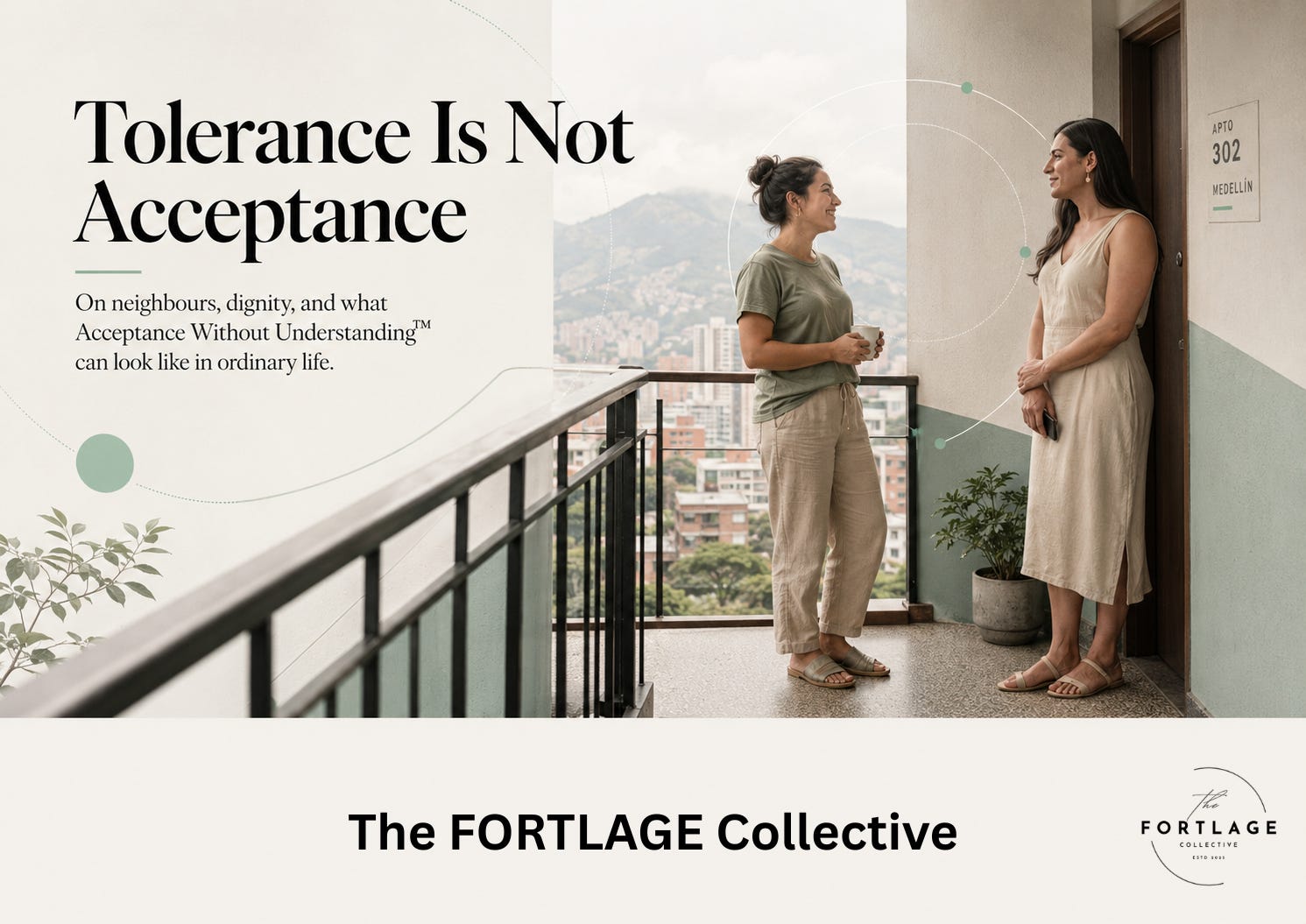
For six months in Medellín, the sentence I said most often was probably: “Yo no hablo español, lo siento.”
I do not speak Spanish. I am sorry.
My Spanish was limited. Their English was limited. Yet somehow, in the middle of the first COVID-19 lockdown, there was enough language for ordinary life.
I found a place to live. I bought food, coffee, and the small things that make daily existence possible when the world outside feels uncertain. I learned the rhythms of an apartment building where greetings mattered: hola, buenos días, buenas tardes, buenas noches.
The encounter that stayed with me did not happen in a meeting, a workshop, a formal conversation, or a carefully facilitated space. It happened in the stairwell.
We lived on the top floor. They lived below us. We had passed each other before, sharing polite greetings and the kind of smiles neighbours exchange when they recognise one another, but do not yet really know each other.
This time, I tried to stretch my Spanish a little further. Nothing profound. Just the kind of small conversation people have when they are trying to be neighbourly in a language they do not fully possess.
They did not step away from the exchange.
They leaned into it.
We stood a few feet apart, because it was lockdown and distance had become part of how we cared for one another. The conversation was brief. It was imperfect. It was not philosophical. It was just neighbours talking.
And then something was said, in the middle of that ordinary exchange, that has stayed with me ever since.
The meaning, as best as I understood it, was simple: I am me. You are you. We can both live our lives here.
It was not grand.
It was not performative.
It was not wrapped in the language of inclusion.
But I felt accepted.
Acceptance is often revealed less in what people claim to believe and more in how they behave when another human being is standing in front of them.
I felt it in my body before I could fully explain it in words.
When I know I am being accepted rather than merely tolerated, something in me releases. The internal weight of assessing safety relaxes. The constant calculation softens. The body stops working quite so hard simply to exist in the space.
For women, for LGBTQ+ people, for racialised people, for disabled people, for anyone whose safety or belonging cannot always be assumed, there is often an additional cognitive load carried into ordinary places. We are not only entering the room. We are reading it. Measuring it. Interpreting tone, posture, silence, distance, humour, eye contact, power, and risk.
That kind of task-switching is exhausting.
So when acceptance is felt, even in a small moment, it can feel physical. A breath lowers. Shoulders soften. Muscles unclench. Some part of the body that had been preparing for rejection, dismissal, curiosity, judgement, or harm realises it may not need to work quite so hard.
That is what I felt in that stairwell.
Not certainty. Not full understanding. Not agreement.
A release.
The sense that, for that moment, I could simply be a neighbour.
Part of why that moment moved me was because of what I had carried into it.
I had spent much of my adult life in the Catholic Church. I was not casually connected to it. I had been baptised into the Church. I had served communion. I had been involved enough to understand the rhythms of Mass, the sacraments, the doctrine, the structure, and the meaning those things carried for people who lived inside that faith tradition.
I was not born into Catholicism. I was born into an Irish Protestant tradition, and I have often joked that becoming Roman Catholic was my second transition in life.
For many years, Catholicism was part of my spiritual home.
And then I left.
I did not leave because every person in my local church rejected me. In fact, my local priest was welcoming. He wanted Cynthia at the service. The congregation I knew was welcoming. There were people there who met me with warmth.
But I also understood the doctrine. I understood the wider structure. I understood that a welcoming local relationship could still sit inside an institution where, at some point, the harder edges of doctrine might be brought to bear.
By then, I had already lived through enough loss. I made the decision that this was not the hill I was going to die on.
So I left, and began a different journey with my own spirituality.
That history came with me to Medellín.
Not as an accusation against every Catholic person I met. Not as a certainty about how people would behave. But as a lived expectation shaped by experience, doctrine, institutional memory, and the knowledge of what it can feel like when welcome depends on someone else’s tolerance.
So when I found myself living in Colombia, in a culture where Catholicism had deeply shaped public and private life, I recognised much of the religious world around me. Even when I did not understand the Spanish, the rhythms of Mass, the sacraments, the gestures, the timing, and the structure did not feel foreign to me.
What felt uncertain was not the religion.
It was whether there would be room for me inside the ordinary human life around it.
That is what made the stairwell moment matter.
It did not resolve every theological question. It did not ask anyone to abandon their beliefs. It did not require a shared language, a shared history, or a shared understanding of gender, identity, doctrine, or difference.
It simply became, for a few minutes, a human encounter where dignity arrived before explanation.
If that moment had been tolerance, I think I would have known.
It probably would not have looked dramatic.
There would have been no outrage. No argument. No sign that anyone was trying to push me out of the building or make my life harder.
It might have looked perfectly polite.
A smile.
A nod.
A quick retreat.
A closed door.
The kind of interaction where nothing openly harmful happens, but something human is still withheld.
That is one of the things tolerance can do. It can appear civil while keeping distance intact. It can avoid cruelty without offering connection. It can decide, quietly, that the easiest way to “accept” someone is to ignore them.
I can tolerate you because I do not have to engage with you.
I can tolerate you because I can keep you at the edge of my life.
I can tolerate you because I can remain unchanged by your presence.
But that is not what happened.
I was not ignored.
They did not make me explain myself. They did not turn me into a debate. They did not pretend not to see me. They did not need to understand everything about me in order to remain in relationship with me as a neighbour.
They simply stayed.
They stayed in the conversation. They stayed in the warmth of the exchange. They stayed in the ordinary dignity of two people sharing a building, a stairwell, a lockdown, and a few imperfect words.
That changed me.
Not because it answered every question I carried about faith, identity, belonging, or safety.
It changed me because it gave me a living example of something I had been trying to name.
Acceptance Without Understanding™ was not only a leadership idea, a teaching concept, or a phrase I used in rooms where difference needed to be held with care.
It was happening there, in ordinary life.
In a stairwell.
Between neighbours.
Across limited language.
Across religious assumptions.
Across difference.
Across everything that might have made distance easier.
And instead, there was dignity.
Organisations do this too.
They may not call it tolerance. They may call it inclusion, awareness, celebration, allyship, or belonging. Sometimes those words are sincere. Sometimes the moments they create are meaningful. I do not want to dismiss the importance of being recognised, especially when recognition has too often been absent.
But recognition in the moment is not the same as sustained acceptance.
Tolerance can show up politely.
It can smile at the awareness day. It can attend the event. It can admire the decorated cupcakes. It can use the right language in the right month. It can change a logo, share a statement, post a message, and say, “We are with you.”
And then it can do very little else.
That is the part we need to be honest about.
For marginalised people, identity is not seasonal. Women are not women only on International Women’s Day. LGBTQ+ people are not LGBTQ+ only during Pride. Disabled people are not disabled only during Disability Pride Month or on a day of awareness. Racialised people do not carry race only when an organisation decides it is time for a campaign.
People live with their identities every day.
The safety questions are daily.
The dignity questions are daily.
The access questions are daily.
The belonging questions are daily.
A day, a week, or a month of recognition may create a welcome moment, but it does not necessarily change the conditions people return to afterwards.
And sometimes, even the moment of recognition places more labour on the people already carrying the weight.
Professional speakers are often expected to contribute for free because the topic is seen as personal rather than professional. If external speakers cannot do that, because they too have mortgages, rents, bills, food, and lives to fund, organisations may turn to their own employees and ask them to carry the emotional labour instead.
Tell your story.
Educate us.
Represent the community.
Help us understand.
Be vulnerable enough to make this moment feel meaningful for others. Then return to work.
That can look like inclusion from the outside.
From the inside, it can feel like tolerance dressed in celebration.
Because tolerance often asks people to be visible when it is useful, but not necessarily powerful when it matters.
It opens the door for the event.
Then quietly closes other doors afterwards.
The recruitment door.
The promotion door.
The sponsorship door.
The decision-making door.
The informal relationship door.
The door to being treated as someone with authority, complexity, ambition, knowledge, and ordinary human needs.
I have felt those closed doors.
Many people have.
The polite smile. The warm words. The encouraging tone. The sense that everyone knows how to behave in the moment, but not how to change the pattern.
That is why the stairwell in Medellín stayed with me.
Because my neighbours did not perform a moment and then withdraw from me.
Afterwards, when we passed each other, there was still warmth. Still recognition. Still the smile of people who had decided, in some ordinary but meaningful way, that we could share space as neighbours.
It did not need a banner.
It did not need a campaign.
It did not need the right month.
It was behaviour.
And behaviour is where acceptance becomes real.
For organisations, this is where the work becomes more demanding.
It is not enough to say, “We have a policy.”
Policies matter. They are foundational. They create expectations, protections, standards, and routes of accountability. Without policy, inclusion is often dependent on goodwill, and goodwill is not a governance model.
But policy is not the same as culture.
A policy can say someone is protected.
It cannot, by itself, make them feel seen.
A policy can say discrimination is not acceptable.
It cannot, by itself, teach a manager how to respond when someone’s difference makes them uncomfortable.
A policy can create a foundation.
But behaviour determines whether people can actually stand on it.
That is the leadership lesson.
Leadership is behaviour.
Not title. Not role. Not authority. Not a line on an organisational chart.
A supervisor, manager, director, executive, or CEO may have positional authority. They may have decision rights. They may carry operational responsibility. They may be the most senior manager in the organisation.
But leadership is created in relationship with people.
It is created through the daily behaviours that tell others whether they are safe to contribute, safe to ask, safe to challenge, safe to be visible, safe to need something, safe to be different, and safe to remain fully human in the room.
That does not mean leaders need to become everyone’s friend.
In fact, leadership often requires boundaries. It requires judgement. It requires the ability to care about people without confusing care with overfamiliarity, favouritism, or avoidance of accountability.
But it does mean leaders need to understand that behaviour is never neutral.
The smile matters.
The silence matters.
The follow-up matters.
The invitation matters.
The closed door matters.
The person who is included in the celebration but not in the decision matters.
The employee asked to share their lived experience for free, but not considered for promotion, matters.
The leader who says the right words publicly but avoids meaningful proximity privately, matters.
Tolerance can behave nicely while keeping distance intact.
Acceptance behaves with the intention that the other person’s dignity will be felt in the interaction.
That does not require perfect understanding.
It does not require agreement.
It does not require the leader to have lived the experience themselves.
But it does require a decision about behaviour.
If I am going to interact with this person, will I do so in a way that makes them feel merely endured, or in a way that makes their humanity feel recognised?
That was what my neighbour gave me in the stairwell.
Not a policy.
Not a slogan.
Not an event.
A behaviour.
A brief, ordinary, human behaviour that said: I see you. I am not turning away. We can share this space.
And that is where acceptance becomes real.
Do not be the person who smiles politely, nods, and closes the door. Be the neighbour who stays long enough for dignity to be felt.
Perhaps that is the question I want leaders to sit with.
Not only, “Do we tolerate difference?”
Not only, “Do we have the right policies?”
Not only, “Did we mark the right day, post the right message, or say the right thing when people were watching?”
Those questions matter, but they are not enough.
The deeper question is: when difference is standing in front of us, in ordinary life, how do we behave?
Do we smile, nod, and close the door?
Or do we stay in the exchange long enough for dignity to be felt?
That is what my neighbour did in the stairwell.
They did not need perfect language. They did not need full understanding. They did not need a shared history, shared theology, or shared experience of the world.
They simply did not turn away.
They allowed an ordinary human moment to remain human.
And that is where acceptance begins.
Not in the performance of welcome.
Not in the politeness of distance.
Not in the temporary visibility of a celebration.
But in the behaviour that tells another person: your presence does not need to be explained away before it can be met with dignity.
Tolerance may keep the peace.
Acceptance creates the conditions for belonging.
So if this piece leaves you with anything, perhaps let it be this:
Think about the doors you close politely.
Think about the people you smile at but do not make room for.
Think about the moments when you have mistaken non-hostility for inclusion.
And then think about the neighbour in the stairwell.
The one who stayed.
The one who smiled afterwards.
The one who reminded me that Acceptance Without Understanding™ does not always arrive as a grand statement.
Sometimes it arrives as a simple human choice:
I am me.
You are you.
We can share this space with dignity.