

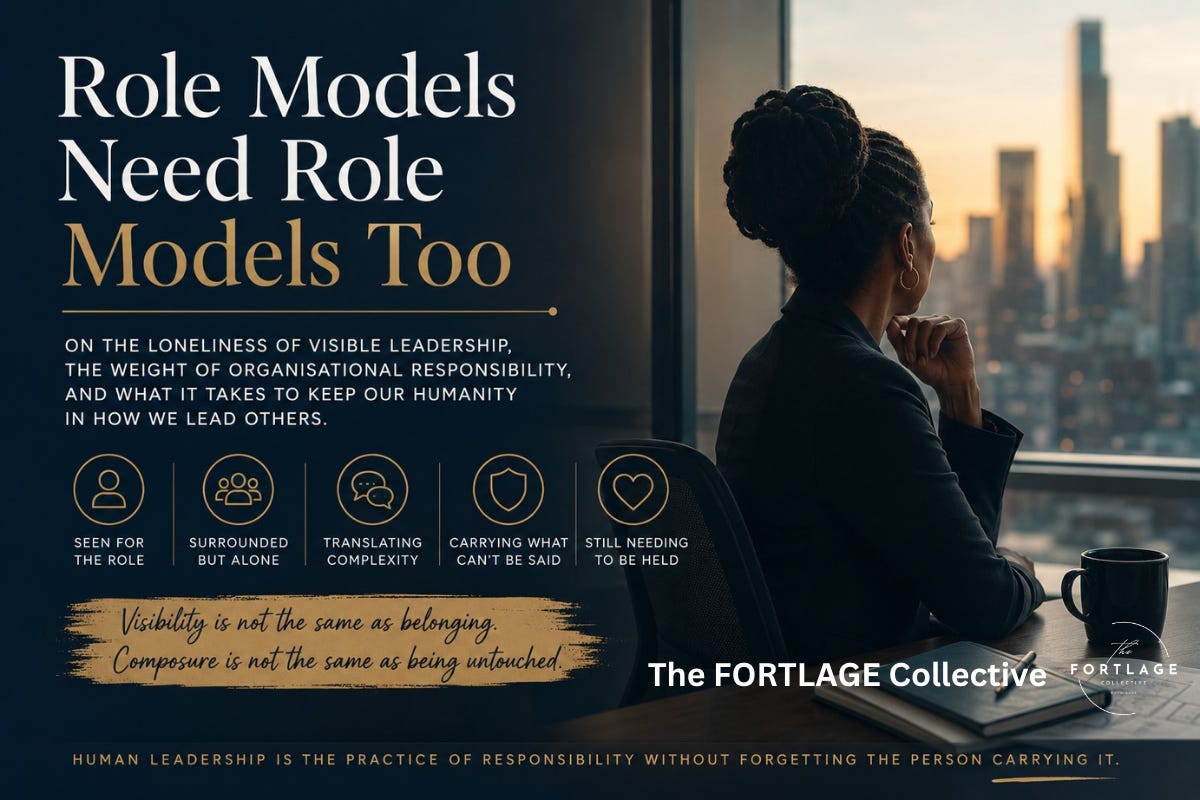
Role Models Need Role Models Too
On the loneliness of visible leadership, the weight of organisational responsibility, and what it takes to keep our humanity in how we lead others.
There is a kind of loneliness in leadership that is difficult to explain from the outside.
It is not the loneliness of having no one around you.
It is the loneliness of being surrounded by people who know your role, your title, your reputation, your usefulness, and your public value, while very few know what it is costing the person underneath.
I know that loneliness from the inside.
I spent decades in corporate leadership, including as a CIO, carrying the responsibilities, expectations, and visibility that come with being the person others look to when the stakes are high. In 2016, I was named one of the Top 20 most influential CIOs in North America. From the outside, that kind of recognition can look like arrival.
From the inside, it can also become a place where there are fewer and fewer people with whom you can speak honestly.
I was not without people.
I had networks. I had friends. I had personal support. I had communities where parts of me could breathe.
What I did not have was a peer or mentor who understood the particular complexity of being visible, senior, politically exposed, identity-conscious, and responsible for decisions that affected an entire organisation.
I did not need someone to tell me the technical answer.
I had the technical answers. I had spent years building the knowledge, experience, judgement, and relationships required to operate at that level. I knew my sector. I knew my discipline. I knew the work.
What I needed was someone who understood the leadership reality around the answer.
The politics. The brand implications. The fear. The uncertainty. The doubt. The pressure to simplify what was not simple. The knowledge that some truths cannot be safely spoken in the room where decisions are being made.
That is a particular kind of loneliness.
Not the loneliness of incompetence. Not the loneliness of being unprepared. Not the loneliness of not knowing what to do.
The loneliness of knowing that the work is complex, the stakes are high, the consequences are real, and the language available to you is often too narrow for the reality you are carrying.
In leadership, especially senior organisational leadership, you learn very quickly that not everything can be said everywhere.
You may have peers, but peers are not always safe. You may have colleagues, but colleagues are also navigating their own politics, ambitions, fears, and loyalties. You may have a team, but the team also needs to trust that you can hold the weight of what they cannot yet see.
So you carry more than the role description ever says.
You carry the complexity of the work. You carry the translation of that complexity into language others can use. You carry the emotional regulation required to make uncertainty sound manageable. You carry the organisational confidence people need from you, even when the reality is far more nuanced than the room wants it to be.
For much of my corporate career, I was translating.
I was translating technology into business language. I was translating risk into strategy. I was translating complexity into something that could be understood by people who did not need to live inside the detail, but still needed to make decisions about it.
And, over time, I was also translating myself.
Not into another language, but into acceptability.
I was learning what parts of me could be seen without creating discomfort. What parts needed to be softened, delayed, edited, or hidden. What parts of my uncertainty could be named, and what parts would be read as weakness. What parts of my identity could be managed privately so that my public leadership remained recognisable to others.
That is not the same as Acceptance without Understanding™.
Acceptance does not require a person to become smaller, simpler, or easier to categorise before dignity is offered. But acceptability often does. Acceptability asks us to keep translating ourselves until other people feel comfortable enough to recognise us.
That is the part visible leadership does not always name.
You learn what parts of you are acceptable in the room. You learn what language creates confidence and what language creates discomfort. You learn how much of your humanity people can tolerate before they begin to question your authority. You learn how to carry fear, uncertainty, and doubt without showing too much of any of it.
In business, we often talk about fear, uncertainty, and doubt as if they are external forces to be managed.
We put risk into frameworks. We assign probability. We build mitigation plans. We create dashboards, papers, and governance structures. We make uncertainty presentable.
But the human experience of carrying uncertainty often has nowhere to go.
Especially when that uncertainty is not only about a project, a budget, a system, or a strategy, but about you.
At one point, while thinking through risk related to my own identity, I realised something that stopped me.
My identity could be seen as a brand problem for the organisation.
Not because my capability had changed.
Not because my judgement had changed.
Not because my commitment, experience, or leadership value had disappeared.
But because the organisation did not know how to behave in relation to what it did not yet understand.
That distinction matters.
The risk was never my identity.
The risk was the uncertainty others felt in relation to my identity, and the behaviour that uncertainty produced.
This is where leadership becomes very real.
Because policies matter. Guidance matters. Strategy matters. Statements of inclusion matter. Values matter.
But all of it eventually becomes behaviour.
How do people behave when difference is no longer theoretical?
How do they behave when complexity sits close to power?
How do they behave when the person they have celebrated, depended on, promoted, recognised, or associated with the brand becomes harder for them to categorise?
That is where organisational culture tells the truth about itself.
Not in the easy moments.
In the exposed ones.
Visibility has given me a great deal.
It has given me influence. Recognition. Purpose. Invitations into rooms where meaningful conversations can happen. The opportunity to be consulted, trusted, and seen as bringing value in a way that is distinctively mine.
I do not dismiss any of that.
I know what visibility can make possible. I know what it means to have work recognised, to be invited to contribute, to be trusted with difficult conversations, and to feel that your experience may help someone else see something differently.
There is power in that.
There is also responsibility.
But visibility also has a cost.
Too often we talk about visible leadership as if recognition cancels out loneliness. As if purpose cancels out grief. As if influence cancels out the need to be held as human.
It does not.
Being visible does not mean being fully seen.
Being trusted does not mean being fully supported.
Being recognised does not mean being protected from loss.
There are parts of visible leadership that people will never see from the outside.
I keep a private list of losses that came with choosing to live more truthfully. There are twenty-two items on it. I do not share that number for sympathy, and I do not share the list in full because not every part of our lives belongs in public view.
But the first few items are not small.
Family. Marriage. Career. Belonging. Grief.
Each of those words carries a story. Each of those stories carries people, history, love, complexity, and consequences. None of them can be reduced to a leadership lesson, and I would not want them to be.
But they are part of the truth.
Visibility is often discussed as empowerment. Sometimes it is. It can open doors, build connections, create representation, and help others imagine themselves differently.
But visibility can also make you easier to project onto.
It can make you easier to celebrate, easier to misunderstand, easier to use as proof of progress, and easier to distance from when your humanity becomes inconvenient.
That is why role models need role models too.
Not because they are weak.
Because they are human.
Because being looked to is not the same as being accompanied.
Because being able to hold others does not mean you have no need to be held.
Because leadership does not remove the need for care, reflection, perspective, or honest conversation. It often makes those things more necessary.
The more visible a leader becomes, the easier it is for people to confuse composure with certainty.
They see the role. The title. The awards. The public voice. The carefully chosen words. The ability to stand in front of a room and hold complexity with apparent ease.
They do not always see the private work underneath.
The self-regulation.
The questions not asked aloud.
The grief held until later.
The parts of the story edited for safety.
The exhaustion of being interpreted before being understood.
The discipline of turning pain into language others can hear.
That discipline can be useful.
It can also be costly.
And if leaders are not careful, they can begin to believe that the composed version of themselves is the only version that deserves to be in the room.
The answer is not for leaders to overshare.
It is not for every senior person to turn every room into a place for their own processing.
That would not be leadership either.
There is a difference between grounded vulnerability and emotional absence.
There is also a difference between being human in how we lead and making others responsible for carrying what we have not processed.
That distinction matters.
Because somewhere along the way, many leaders learn that humanity is a liability.
They learn that uncertainty must be polished before it is spoken. That doubt must be hidden behind confidence. That complexity must be simplified beyond recognition. That grief, fear, confusion, and exhaustion must be managed privately so that the organisation can keep believing in the role.
Some of that discipline is necessary.
Leadership does require judgement. It requires emotional regulation. It requires timing, boundaries, and care. It requires knowing what belongs in the room, what belongs in trusted conversation, and what must be worked through elsewhere before it is brought into the lives of others.
But when leaders hide all uncertainty, everyone else learns to hide too.
When leaders pretend complexity is simple, people learn to bring only simplified truths upward.
When leaders perform certainty, teams learn that doubt is dangerous.
And when leaders disconnect from their own humanity, they often begin to lead in ways that make it harder for others to bring theirs.
That is the part organisations need to understand.
Human leadership is not softness.
It is not indulgence.
It is not the absence of accountability.
It is the disciplined practice of remaining connected to people while carrying responsibility, pressure, consequence, and complexity.
It is being able to say, “This is difficult,” without making difficulty the whole story.
It is being able to say, “I do not have every answer yet,” without abandoning the responsibility to find one.
It is being able to listen without collapsing, decide without dehumanising, and lead without pretending the human cost is irrelevant.
That kind of leadership matters because people do not give their best work to systems that require them to disappear.
They may comply.
They may perform.
They may deliver what is required.
But discretionary effort, the willingness to contribute more than the minimum, to think deeply, to speak honestly, to care about the outcome, to offer the insight that was not explicitly requested, is unlocked in environments where people believe their humanity will not be used against them.
Leaders shape those environments through behaviour.
Not only through policies.
Not only through values statements.
Not only through strategy decks or leadership competency frameworks.
Through behaviour.
Through what they make safe.
Through what they punish.
Through what they ignore.
Through what they model when uncertainty enters the room.
Through how they respond when difference becomes personal, visible, and close to power.
That is why this conversation matters.
Because the loneliness of visible leadership is not only a private leadership wound. It is also an organisational signal.
It tells us something about what the culture can and cannot hold.
It tells us what kinds of truth can safely be spoken.
It tells us whether people at the top are allowed to remain human, and whether the people below them are expected to become smaller in order to survive.
If role models have no role models, they may still keep going.
Many do.
They may keep delivering, performing, absorbing, translating, regulating, smiling, deciding, representing, and holding the line.
But something gets lost.
And when leaders lose connection to their own humanity, the people they lead often feel the distance long before anyone names it.
Role models need role models too
I think often about the leader I was then.
I do not look back at her with judgement.
I look back at her with tenderness.
She was doing what so many leaders are taught to do. Carry the weight. Translate the complexity. Protect the organisation. Hold the line. Stay composed. Keep going.
And she did keep going.
She built credibility. She delivered. She earned trust. She was recognised. She became someone others looked to.
But she was also lonelier than many people knew.
If I could speak to her now, I would not tell her to want less. I would not tell her to care less. I would not tell her to lead less, strive less, or become less visible.
I would tell her to build places where she did not have to translate quite so much of herself before being recognised as human.
I would tell her that being a role model does not remove the need for role models.
It makes that need more important.
Because role models are not symbols.
They are people who have learned, often at significant cost, how to stand where others can see them.
And people who are seen still need somewhere they can be held.
Not held in a way that removes responsibility.
Not held in a way that excuses harm, avoids accountability, or turns leadership into self-protection.
Held in a way that allows reflection. Perspective. Honesty. Humanity.
Held in a way that reminds them that the role is not the whole person.
That the title is not the whole self.
That visibility is not the same as belonging.
And that composure is not the same as being untouched.
This is not only a personal lesson.
It is an organisational one.
If organisations want leaders who can build trust, create psychological safety, hold complexity, navigate difference, and unlock the kind of discretionary effort that comes from people feeling genuinely safe to contribute, then those organisations must also ask what kind of leadership they are rewarding.
Are they rewarding leaders who remain human enough to hear the truth?
Or leaders who have become so polished, so protected, so distant, and so fluent in certainty that people no longer know whether honesty is safe?
Are they creating cultures where visibility is accompanied by care, reflection, challenge, and support?
Or cultures where the most visible people are quietly expected to absorb the cost alone?
The goal is not for leaders to be less visible.
Visibility matters.
Representation matters.
Public trust matters.
Leadership presence matters.
But the goal cannot be visibility at the expense of humanity.
The goal is for visible leaders to remain whole enough to lead others humanely.
That is why role models need role models too.
Because the people others look to still need people they can look to.
Because the people who hold complexity still need places where complexity can be held.
Because the people who create safety for others still need spaces where their own humanity is not treated as a weakness.
And because leadership, at its best, is not the performance of certainty.
It is the practice of responsibility without forgetting the person carrying it.