

Executive Summary: Draft EHRC Code
Executive Summary: Early Operational Reflections on the Draft EHRC Code
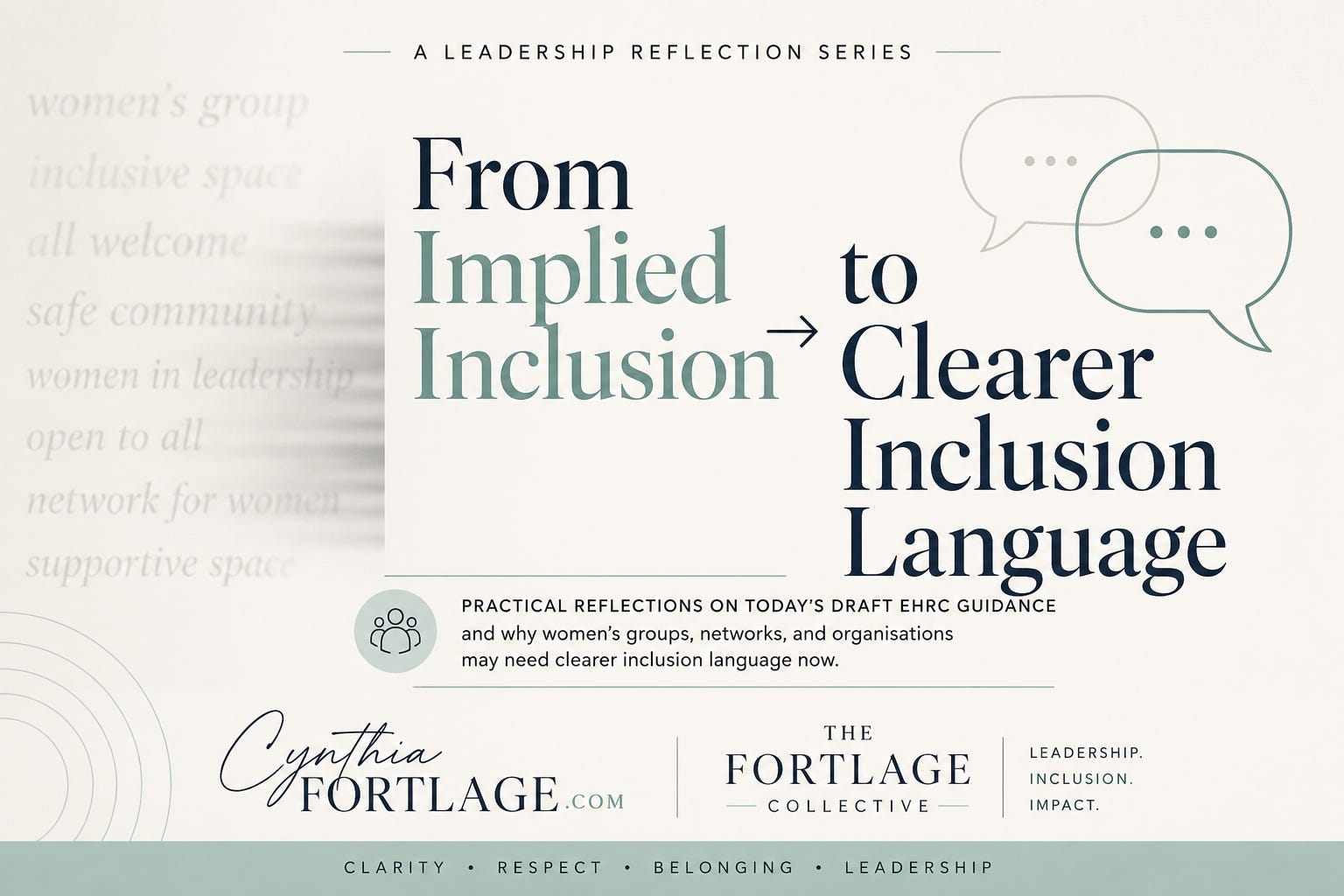
On 21 May 2026, the UK Equality and Human Rights Commission (EHRC) released a draft Code of Practice connected to the Equality Act and the recent Supreme Court ruling regarding sex and gender.
This draft Code applies to England, Scotland and Wales. Northern Ireland has separate equality law.
The draft Code has been laid before Parliament but is not yet in force. If approved following the parliamentary process, it would later be commenced by order.
The guidance is new, legal analysis is still unfolding, and organisations will continue refining their understanding as specialist reviews, parliamentary process, and practical interpretation develop. This summary is not legal advice. It is an early operational and lived-experience reflection intended to help leaders, organisations, networks, event organisers, and community groups begin thinking clearly and respectfully about what may need attention.
The most immediate shift is not simply legal. It is operational.
Many organisations have historically relied on implied inclusion. They used broad language such as “inclusive space,” “women’s network,” “safe community,” or “open to all” and trusted that people would understand who was included.
That may no longer be enough.
The draft Code places renewed attention on services, public functions, associations, membership, facilities, participation, access, and single-sex or separate-sex provision. For organisations, this means clarity will matter more.
Leaders may need to review:
how groups, networks, and associations describe membership
whether participation criteria are clear
how events communicate access and facilities
whether venues provide suitable toilet, changing, or privacy options
how online groups and informal communities describe inclusion
whether staff and organisers understand the difference between sex-based, gender-inclusive, ally-inclusive, and open participation spaces
how to reduce the burden on individuals to ask whether they belong
The practical lesson is not that every organisation must suddenly change who it includes.
In many cases, the first step may simply be describing more clearly the inclusion already being practised.
That could mean clarifying whether a group is:
sex-based
gender-inclusive
trans-inclusive
non-binary-inclusive
women and gender-diverse
ally-inclusive
open to all
This is particularly important for women’s groups, employee networks, community spaces, events, leadership programmes, and membership organisations where inclusion may previously have been socially understood rather than explicitly stated.
Facilities also require careful attention. Organisations and event organisers should not assume that generic inclusion language is enough if the physical environment does not support dignity, privacy, safety, and access. Venue selection, toilet provision, changing facilities, overnight accommodation, and event communications may all need more intentional review.
A key leadership risk is shifting the burden of clarification onto individuals.
People should not have to out themselves, privately message organisers, ask at reception, or negotiate belonging at the door simply to understand whether they can participate safely and with dignity.
The organisations that handle this best will not be the loudest. They will be the clearest.
They will communicate carefully, document their reasoning, seek legal advice where needed, and focus on dignity, privacy, safety, proportionality, and respectful behaviour.
The emerging leadership question is simple:
How do we create clarity without losing humanity?
That may be one of the most important organisational challenges in the weeks and months ahead.